National Cancer Plan: A welcome vision born from tragedy, but families need support today
4 February 2026
The National Cancer Plan is a welcome commitment to improving cancer outcomes, including for children and young people. This represents political will and years of advocacy by charities, clinicians and families.
On World Cancer Day 2026, the UK government unveiled its landmark National Cancer Plan for England. For the first time in the country’s history, children and young people have a dedicated standalone chapter within the plan. This level of dedicated attention to childhood cancer is rare internationally, with only 4 out of 22 European countries having comprehensive approaches to childhood cancer.
Every child should have their whole life ahead of them. The reality is the 10 children diagnosed with cancer today, will face the same challenges their families confronted last week.
The ambition of the plan will be welcomed by many, but the improvements outlined will take years to materialise. This is precisely why charities like Children with Cancer UK and others remain vital.
Sophie’s Legacy: Where this all began
The childhood cancer focus, within the plan, originated with Sophie Fairall, a 10-year-old girl from Stubbington who sadly passed away in September 2021 from Rhabdomyosarcoma, a very aggressive form of cancer. Sophie’s diagnosis followed weeks of illness during which red flag indicators for cancer were overlooked, a tragedy that highlighted the urgent need for better awareness and early detection of childhood cancer.
Ten days after Sophie’s passing, her mother Charlotte Fairall met with her local MP, Dame Caroline Dinenage, seeking to transform her daughter’s experience into meaningful change. Together, they proposed a Childhood Cancer Mission developed by a taskforce that would include scientists, researchers, oncologists, charities and parents. Today’s National Cancer Plan, with its dedicated chapter for children and young people, represents the fruition of Sophie’s legacy and the tireless work of her mother, Dame Caroline, alongside the many charities and clinicians who joined their cause.
What families facing childhood cancer will see and when:
£10 Million Travel Fund: Announced, not yet available
The centrepiece of the childhood cancer support package is a £10 million annual fund to cover travel costs for all children and young people with cancer and their families, regardless of income. This addresses much needed support a critical gap identified by charities, Young Lives vs Cancer’s campaign found that 71% of families struggled to meet travel costs, and one in ten had missed or delayed treatment due to inability to afford travel.
For nearly a decade, Children with Cancer UK has provided essential financial support to help families manage these unavoidable travel expenses. We therefore warmly welcome this new government fund as a vital step forward. It ensures that every family receives the help they need, while recognising and building on the longstanding support charities like ours have been delivering for years.
With 13 specialist children’s cancer centres across England, more than a third of families must travel over an hour to reach hospital, often several times weekly for months or years. Until this fund is accessible, these costs remain a significant barrier.
Waiting time targets are three years away
The plan commits to the NHS meeting all cancer waiting time standards by March 2029. Currently, only 70.2% of patients are treated within the 62-day target (the target is 85%).
Between April and November last year, there was only a 0.1% improvement in the proportion of patients waiting under 62 days to start cancer treatment. To meet the Government’s target of 85% starting treatment within this timeframe by the March 2029, we’d need to see improvements of almost 0.4% every single month. Until then, children diagnosed today will face the same waiting times that have persisted for years.
Earlier and more accurate diagnosis
The plan commits to ensuring the earliest possible accurate diagnoses within primary and secondary care settings, building on research and recommendations from CCLG’s Child Cancer Smart awareness campaign. The £2.3 billion investment in diagnostics will deliver 9.5 million additional tests by 2029, the rollout will be gradual over the next three years.
Enhanced access to clinical trials and genomic testing
Every patient who could benefit will be offered genomic testing that analyses the DNA of their cancer, helping doctors identify the most effective treatments. The plan also commits to improving access to clinical trials. Specific timelines for expanding genomic testing and trial access are yet to be announced. Some expansion is underway, but comprehensive availability remains a work in progress.
Comprehensive psychosocial support
Recognising that the impact of cancer often surfaces years after treatment ends, the plan standardises mental health support for all young cancer patients during diagnosis, treatment and long-term follow-up. Youth support coordinators will help teenagers and young adults with education, emotional support and fertility concerns.
Research prioritisation
The plan prioritises funding for children and young people’s cancer research and improved data collection. This addresses the urgent need for new effective therapies, particularly for high-risk and rare cancers where evidence gaps remain significant.
The long-term vision
The broader National Cancer Plan sets ambitious targets:
- 75% of patients diagnosed from 2035 will be cancer-free or living well after five years
- 320,000 more lives saved over the lifetime of the plan
- Expansion of robot-assisted procedures from 70,000 to 500,000 by 2035
- More patients with rarer cancers treated at specialist centres
The most ambitious survival target applies to children diagnosed from 2035 onwards.
The Essential Role of Cancer Charities: Driving the innovation
In the UK, cancer charities:
Fund groundbreaking research: While the NHS budget focuses on service delivery, charities fund the specialist research that discovers new treatments. Children with Cancer UK alone has funded over 300 research projects with more than £300 million invested since 1988. Around 2% of cancer research funding historically goes to childhood cancer with charities endeavouring to fill this critical gap.
Children with Cancer UK has a proven track record of backing research that becomes standard NHS care. Over twenty years ago, we co‑funded the clinical work that led to the Minimal Residual Disease (MRD) test for leukaemia, now routinely used across the NHS. We also invested £3.7 million to launch the national Precision Medicine programme in 2017, which helped pave the way for SMPaeds1 and SMPaeds2 and has driven more personalised, less toxic treatments for children. Alongside this, our funding for specialist research centres and innovations such as CAR‑T therapy continues to ensure the UK leads in developing child‑specific cancer treatments.
Drive innovation: Many of the “cutting-edge technologies” and “pioneering trials” mentioned in the National Cancer Plan emerged from charity-funded research. The genomic testing, targeted treatments, and less toxic therapies that are now becoming standard care often started in charity-funded laboratories.
Enable clinical trials: Charities provide crucial funding and infrastructure to make trials happen.
Support patients now: While government plans take years to implement, charities provide immediate practical support, from covering costs the NHS doesn’t, to funding respite for families and providing psychosocial support.
Why we exist
Everyday 10 children will receive a cancer diagnosis. 2 will not survive, but of the 8 that do over half will face long-term and life-limiting side effects. Your support can ensure that more young people survive their cancer but also thrive beyond it.
With the right support and investment childhood cancer doesn’t have to be a life sentence. A major gift to Children with Cancer UK can provide vital, life-saving research.
Watch Professors Zoe Walters and Bruce Moreland talk about the importance of funding childhood cancer research:
Please Support Kinder Cancer Treatments
Philanthropy
Thank you for considering making a donation to Children with Cancer UK. Our Philanthropy team are here to help guide you to make a lasting impact and achieve your philanthropic goals. If you are considering making a major gift, please get in touch:
Give quickly, easily and securely – donate online
Every contribution brings us one step closer to better treatments, improved outcomes, and hope for families affected by childhood cancer.
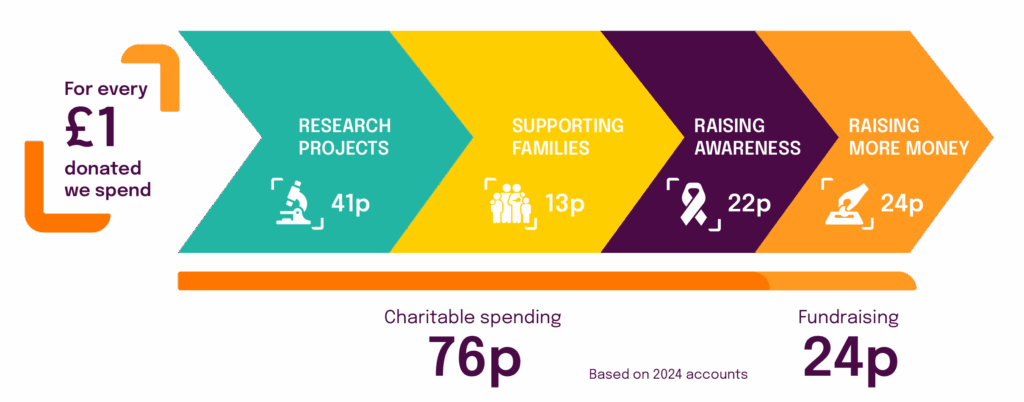
*estimated amount based on data from the NCRI Cancer Research Database (CaRD) for 2018/19.
(To respect the dignity and privacy of those who share their story with us, we sometime use stock imagery and wording such as removing identifiable personal information including name and location.)