Tia’s Acute Lymphoblastic Leukaemia Story
“Adult cancer drugs are too big for children. We must find childhood cancer treatments that fit.”
Shaima, Tia’s mum
Support children like Tia so that they have a future they deserve.

Noticing something was wrong
When Tia was born, she was almost silent, a quiet, easy baby who barely cried. She grew into an energetic, chatty, and curious little girl who loved sports, cooking, science and life. By nine months she was already talking. Her mum Shaima knew early on: “I’ve got a lot coming ahead.”
Tia was four years old when everything changed.
In the weeks before her diagnosis, Tia grew tired and withdrawn. She stopped wanting to play. She complained of night sweats, neck pain and aching legs. The family made eight trips to hospital and two GP visits. Blood tests were run, but a crucial result, the full blood count, was lost in the system. On one visit, a doctor suggested Tia was seeking attention because of her brother’s special needs.
Shaima took Tia out one morning. At Starbucks, the four-year-old looked at her mum and said: “I don’t feel okay. There’s something wrong with me. I really need the doctor to see me.” On their next visit, a doctor heard those words and ran a simple blood test. That was all it took.
The diagnosis
Shaima remembers the moment clearly: sitting with the consultant, the clinical nurse specialist and Tia’s father. “That was the first time we ever heard the word cancer,” she says. “I remember instantly crying my eyes out.”
When she opened the door to the waiting room, her whole family was gathered outside. She walked out and told them Tia’s diagnosis – dry-eyed. “That was the peak of my emotion. I dealt with it in that room. And then I was ready to face it.” Tia had been diagnosed with ALL — acute lymphoblastic leukaemia, B-cell.
Facing cancer as a family
From the start, Shaima made it her role to explain Tia’s illness to her in ways a child could understand – using analogies about school, support and teamwork. Years later, Tia speaks like a doctor. Back then, she needed her mum to translate.
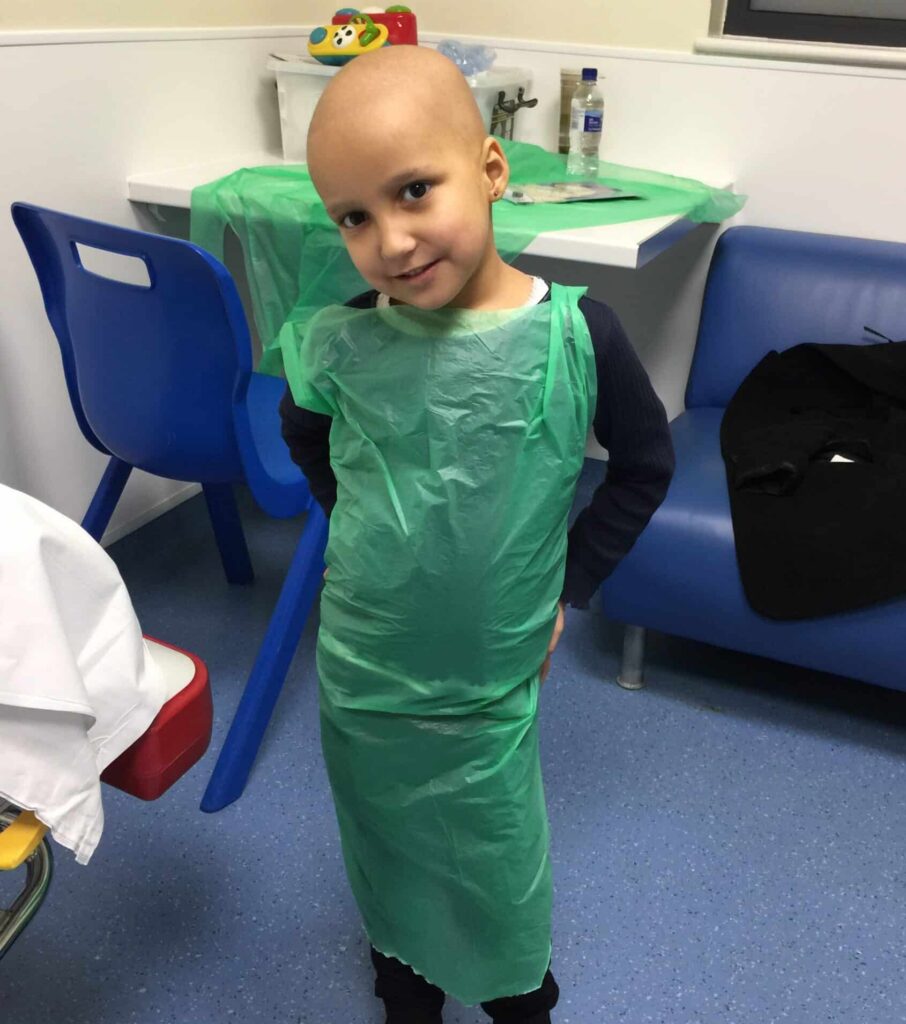
When Tia was told she would lose her long, curly hair, Shaima went to the salon and had her own hair cut short. She walked into Tia’s room. Tia looked at her. “Mummy! You cut your hair! You look really beautiful.” Then, quietly: “I want to look like you.”

One size fits all – in practice
Tia’s initial treatment was two years of chemotherapy on a randomised trial. She reached remission. Then she relapsed. Further treatment with an immunotherapy drug called blinatumumab – one of only five children ever to receive it at the time. However, the treatment couldn’t reach the cancer in her brain. Tia relapsed again during treatment, underwent a bone marrow transplant and full-body radiotherapy, and relapsed a third time three years later. She then received chemotherapy and CAR-T cell therapy.
All of these drugs were designed for adults bodies.
The impact of treatment
The toll on Tia’s growing body has been profound. She has neuropathic damage, weakness, and uses a wheelchair much of the time. The radiotherapy has affected her brain cells, memory and cognition. Her hormonal system has been disrupted, leaving her unable to grow at a normal rate, without natural puberty and Tia is infertile. At 8 years old Shaima had to speak to her daughter about additional surgery to remove and freeze one of Tia’s ovaries, in the hope they could attach it again and have children. “No child or mother should have to be faced with that conversation or decision as a result of cancer treatment.” Shaima explained. Tia now requires hormone replacement therapy.
“Why should that be the price my daughter pays? The cancer treatment may have saved her life – but if the drugs were designed for children, it could avoid all of this. Or many of them, at least.”
Shaima, Tia’s mum
Video caption
Focusing on tomorrow
Tia is now 13. She connects more easily with adults than with children her own age – the medical world has been her world. Her closest friends are those who have been with her since childhood, who came to the hospital and stayed.
Shaima tries to give Tia back the childhood she has missed: taking her out, being silly together, talking about the things her peers talk about. “I just want her to be happy and healthy,” she says. “I don’t care how or what she does with her life, as long as she’s living it to the fullest.”
“These children are the future. If we’re not funding the right drugs for them, they are not going to be the future. That’s where we need to invest right now.”
Shaima, Tia’s mum
Shaima is clear about what must change. Only 2% of cancer research funding goes to childhood cancer. Every drug Tia has received was designed for adults and adapted – imperfectly – for a small, growing body.
Her message is simple, and urgent: “Adult cancer drugs are Too Big for children. We must find childhood cancer treatments that fit.“