Understanding the control of a cancer causing protein in Desmoplastic Small Round Cell Tumour (DSRCT) to develop new targeted treatments.
Project Details
- Exploiting protein degradation regulation to treat desmoplastic small round cell tumour
- Lead Researcher
- Dr Rob Sellar
- Research Centre
- UCL Cancer Institute
- City & Institution Postcode
- London, WC1E 6HX
- Start Date
- 01/02/2026
- Project Duration
- 36 months
- Grant Amount
- £336,791.83
Overview
Desmoplastic Small Round Cell Tumour (DSRCT) is an ultra-rare subtype of sarcoma that affects children and teenagers/young adults. There are limited effective therapies and there have been no advances in treatment in over two decades. As such, outcomes for those affected are poor. DSRCT is caused when DNA has broken and repaired incorrectly resulting in a new fusion and an abnormal protein (EWSR1::WT1). This fusion drives the development of the tumour, is found in all tumour cells, and is not present in normal healthy cells. Removal of the EWSR1::WT1 fusion causes DSRCT cells to die. These features make EWSR1::WT1 an attractive therapeutic. However, direct targeting of fusions in cancer is incredibly challenging.
An emerging aspect of some fusion driven sarcomas is that this abnormal protein has to be kept under very tight control for the cancer cell to be able to survive. The cancer cell achieves this by balancing the production of the protein with the breaking down of the protein (degradation).
While removing the cancer driving fusion results in cell death, too much of the fusion also leads to cell death. This critical balance is often termed the “Goldilocks Principle”. We have evidence that the Goldilocks Principle is relevant to the EWSR1::WT1 fusion in DSRCT. By identifying the cellular components keeping the levels of EWSR::WT1 under control, we aim to disrupt this control using drugs, increase the levels of EWSR1::WT1, and selectively kill cancer cells. If we can achieve this, it will represent a completely different way of designing much needed therapies for individuals with DSRCT.
What difference will this research make?
A key component of this research is to better understand the fundamental disease biology in DSRCT. While this is important, having defined the parts of the cell that are controlling the levels of the EWSR1::WT1 fusion, we aim to effectively translate this new knowledge for the direct benefit of patients.
Current therapies for DSRCT involve surgery, chemotherapy, and radiotherapy. These are intensive treatments and for most individuals with DSRCT ultimately ineffective. We are excited about this project as it has the potential to develop a completely new way of targeting DSRCT – blocking the breakdown of EWSR1::WT1 using drugs and increasing the amount of the EWSR1::WT1 fusion to levels that cancer cells cannot tolerate.
As this approach exploits the presence of the fusion (that is not found in normal cells), this approach has the potential to be more selective for the tumour cells and lead to less toxic yet effective therapies.
About the research team
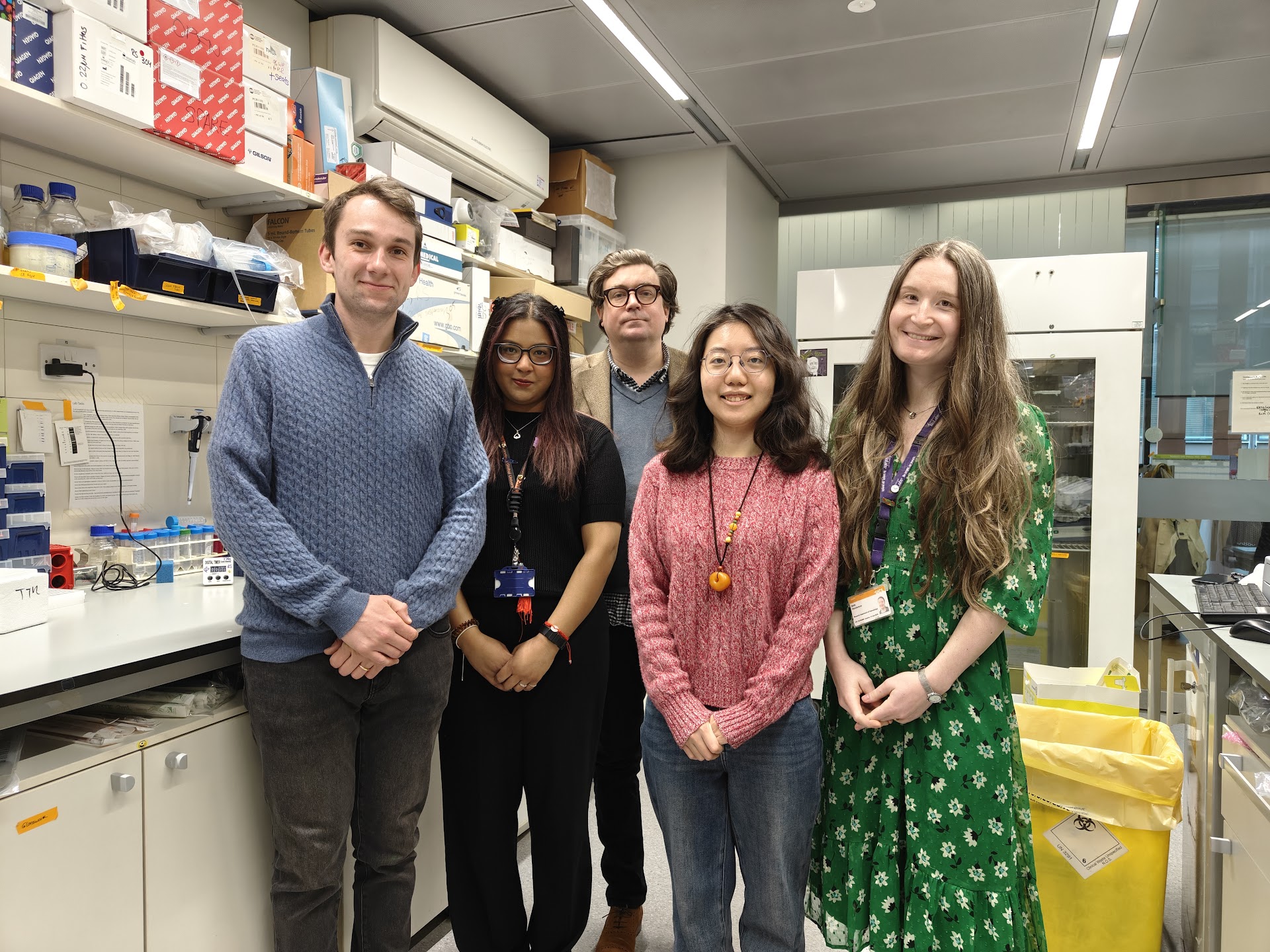
This research builds on an international collaboration of teams that was established to tackle rare sarcomas where there is an urgent need for more effective and kinder treatments.
The teams are led by group leaders from:
University College London (Rob Sellar, Nischalan Pillay, David Selwood)
German Cancer Research Center, Heidelberg (Priya Chudasama)
Gustave Roussy, Paris (Sophie Postel-Vinay)
A key strength of this proposal in the broad range of expertise across the collaboration including
- Genetic screens and fusion proteins (Sellar, Chudasama)
- Sarcoma genetics and biology (Pillay, Postel-Vinay)
- Medicinal chemistry (Selwood)
- Early phase clinical trials in sarcoma (Postel-Vinay)
This collaboration will allow us to effectively translate our new biological insights into the disease on to drug development, and then into the clinic.
Other stories
We have lots of information to help you learn more about childhood cancer. From specific cancer types, to treatments and causes.
Advancing new therapies against germ cell tumours in children and young adults – decreasing side effects, overcoming resistance
The team’s proposal aims to advance a promising new therapeutic approach against germ cell tumours from the bench, towards the clinic and patient benefit.
Read more Advancing new therapies against germ cell tumours in children and young adults – decreasing side effects, overcoming resistance
Tracking the spread of metastatic medulloblastoma to identify key drivers of disease progression and therapeutic vulnerabilities
This research addresses a critical gap in our understanding of how medulloblastoma, a fast-growing and often aggressive brain cancer that primarily affects children, spreads to other parts of the brain and spine (a process called metastasis).
Read more Tracking the spread of metastatic medulloblastoma to identify key drivers of disease progression and therapeutic vulnerabilities
Making immunotherapy more powerful for high-risk acute leukaemia
Making immunotherapy more powerful for high-risk acute leukaemia Project Details Overview The most common cancer in children is a type…
Read more Making immunotherapy more powerful for high-risk acute leukaemia
Dissecting apart the biology of childhood lymphoma in Africa towards improving treatment outcome
Dissecting apart the biology of childhood lymphoma in Africa towards improving treatment outcome Project Details Overview We want to understand…
Read more Dissecting apart the biology of childhood lymphoma in Africa towards improving treatment outcome
Can targeting RNA help treat children with neuroblastoma?
Can targeting RNA help treat children with neuroblastoma? Project Details Overview Neuroblastoma is a childhood cancer that mainly affects babies and young…
Read more Can targeting RNA help treat children with neuroblastoma?
The BIOMECA2 Study: Linking tumour biology to better treatment in a study of an aggressive childhood brain tumour
The BIOMECA2 Study: Linking tumour biology to better treatment in a study of an aggressive childhood brain tumour Project Details…
Read more The BIOMECA2 Study: Linking tumour biology to better treatment in a study of an aggressive childhood brain tumour
Looking for early signs on brain MRIs that can predict whether young people with ependymoma will go on to experience cognitive problems
Looking for early signs on brain MRIs that can predict whether young people with ependymoma will go on to experience…
Read more Looking for early signs on brain MRIs that can predict whether young people with ependymoma will go on to experience cognitive problems
Developing immunotherapy for childhood sarcomas.
Research Developing immunotherapy for childhood sarcomas. Some childhood cancers don’t respond well to chemotherapy, but there is hope in the…
Read more Developing immunotherapy for childhood sarcomas.
Childhood cancer immunotherapy using blood cells from umbilical cord blood.
Research Childhood cancer immunotherapy using blood cells from umbilical cord blood. Immunotherapy is an important new approach in the treatment…
Read more Childhood cancer immunotherapy using blood cells from umbilical cord blood.
Focusing on immunotherapy to target cancer cells without damaging healthy cells
Research Focusing on immunotherapy to target cancer cells without damaging healthy cells Developing new treatments for childhood cancers can be…
Read more Focusing on immunotherapy to target cancer cells without damaging healthy cells