
Groundbreaking fertility procedure offers new hope for childhood cancer survivors
Childhood cancer treatments can have lasting effects on a child’s health, including their future fertility. This pioneering research offers new hope for boys at risk of infertility, bringing us a step closer to helping more survivors achieve their dreams of starting a family.
08 October 2026
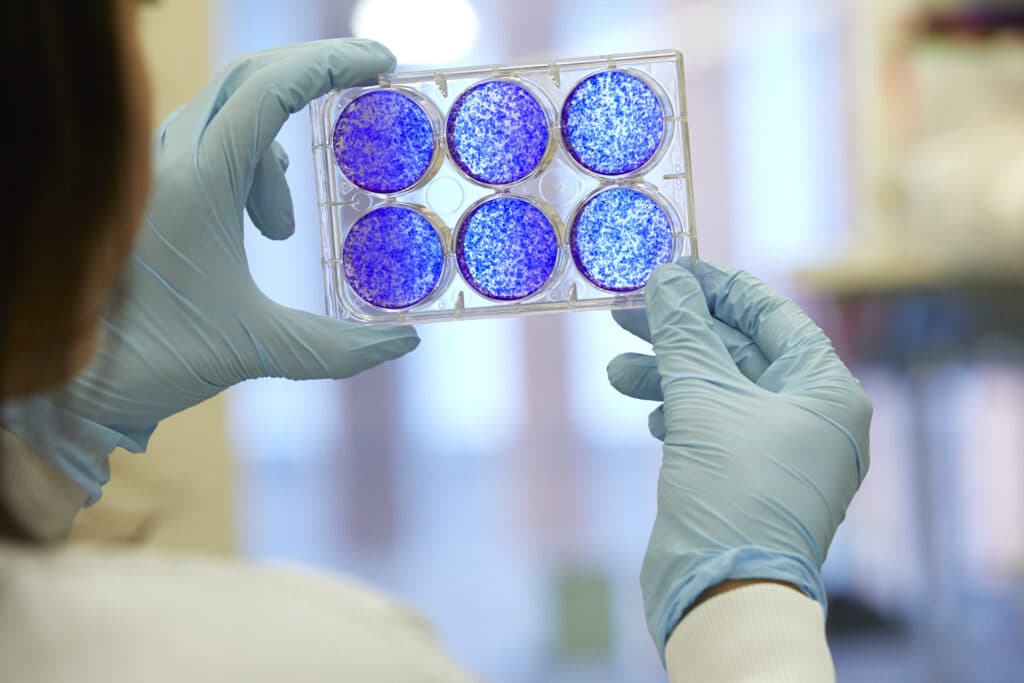
A pioneering medical procedure supported by Children with Cancer UK is offering fresh hope to boys whose cancer treatment could affect their ability to have children in the future.
Doctors in Edinburgh have carried out the UK’s first transplant of frozen testicular tissue, marking a significant milestone in fertility preservation research. The procedure was performed on a 19-year-old patient who had tissue removed and frozen before receiving chemotherapy and a bone marrow transplant to treat a serious blood disorder. Some cancer treatments, including high-dose chemotherapy, can damage the cells responsible for producing sperm. While sperm freezing is available for older teenagers and adults, there are currently very few options to protect the fertility of boys who have not yet reached puberty.
The transplanted tissue contains spermatogonial stem cells, which naturally develop into sperm after puberty. By freezing the tissue before treatment and transplanting it back later, researchers hope it will eventually restore the patient’s ability to produce sperm.
The transplant is only the second reported procedure of its kind worldwide and follows more than a decade of research led by the University of Edinburgh and NHS Lothian.
A decade of research made possible by supporters
Children with Cancer UK has been proud to support this groundbreaking work since 2015, when funding helped establish the Edinburgh testicular tissue preservation programme. The charity provided additional funding in 2024 to support the transplantation study.
Today, the programme has expanded nationally, with more than 1,200 patients across the UK having tissue stored for potential future use.
Hope for future generations
The young man who underwent the procedure said it had given him “genuine hope for the future”.
He explained that he had long worried about the possibility of infertility and had begun to accept that having children of his own might not be possible. Although it is not yet known whether the transplant will successfully restore fertility, he said that having the opportunity to take part in the research means a great deal to him and could help other young people facing similar challenges.
Researchers will continue to monitor his progress over the coming months. Some of the transplanted tissue will be examined in 2027 to determine whether sperm production has begun.
Professor Rod Mitchell, who leads the study at the University of Edinburgh and NHS Lothian, described the procedure as an important step towards helping boys whose fertility may be affected by cancer treatment.
This is a big step towards helping boys facing treatments that damage their fertility to have children of their own. Ten years ago, we started our research programme to freeze and store pieces of testicle from boys before they start chemotherapy, to preserve their fertility. We are beginning to see some of these young men return to explore their fertility options. This study offers real hope for future fertility in boys facing cancer treatment.
Tracey Gillies, Medical Director at NHS Lothian, said
This landmark procedure is an important step forward for young people whose future fertility may be affected by the treatment they need to overcome serious illness. The collaboration between NHS clinicians and researchers at the University of Edinburgh highlights the strength of clinical research in Edinburgh and our shared commitment to improving outcomes for patients across Scotland. This is a significant piece of world-leading work, and we are grateful to the patient and his family for helping advance research that could transform care for others in the future
The UK-based patient, who wishes to remain anonymous, said
Fertility is something I’ve struggled with personally for a long time. I’ve always wanted to have children of my own but at some point, I found myself starting to slowly accept that that might never be possible for me. Having this procedure has given me genuine hope for the future. We don’t know yet whether it will work, but knowing that there is now even a possibility means more to me than I can really put into words. I’m incredibly grateful to everyone for giving me this opportunity and for all the work that has made it possible. I also hope that being part of this research means that, in the future, other young people in the same position can have that hope too
The Edinburgh testicular project was established with funding from Children with Cancer UK
About Children with Cancer UK:
Children with Cancer UK is the leading children’s cancer charity in the UK. Our vision is a world where every child and young person survives cancer and can thrive beyond it.
We fund pioneering research to improve survival rates, enhance quality of life and discover new ways to prevent childhood cancers. Alongside our research, we provide vital support for families navigating diagnosis, treatment, life after cancer and the often enduring side effects they can be left with.
Founded in 1988 as a small memorial charity, Children with Cancer UK has since grown into a national organisation, raising over £300 million and funding more than 300 groundbreaking research projects.
About University of Edinburgh’s Institute for Regeneration and Repair
The Centre for Reproductive Health (CRH), based at the University of Edinburgh’s Institute for Regeneration and Repair, is a world-leading research centre dedicated to improving reproductive health and wellbeing.
Its work spans fertility, pregnancy, contraception, women’s health conditions, gynaecological cancers, and child health, combining pioneering scientific research with clinical expertise to improve outcomes and shape evidence-based care worldwide
Press enquiries:
For all press enquiries, please email [email protected] or call 0800 222 9000 and ask for the media team.
Other stories
We have lots of information to help you learn more about childhood cancer. From specific cancer types, to treatments and causes.

Fundraiser of the Month: Shyanne
Fundraiser of the Month: Shyanne Our Fundraiser of the Month for July 2026 goes to the incredible Shyanne, who has…
Read more Fundraiser of the Month: Shyanne
A week before Daniel’s 3rd birthday, they found a tumour
Daniel was diagnosed with Burkitt’s lymphoma – and a tumour in his stomach area, a week before his 3rd birthday.
Read more A week before Daniel’s 3rd birthday, they found a tumour
Fundraiser of the Month: Steve and Chris
Fundraiser of the Month: Steve and Chris Our Fundraiser of the Month for June 2026 goes to the incredible Steve…
Read more Fundraiser of the Month: Steve and Chris
Too Big Campaign – Press Release
‘2 BIG’: OVERSIZED EVERTON KIT HIGHLIGHTS HARSH REALITY OF CHILDREN RECEIVING ADULT CANCER TREATMENT 11-year-old Kaiden Edwards, who is living…
Read more Too Big Campaign – Press Release
Fundraiser of the Month: Izzy
Fundraiser of the Month: Izzy Our Fundraiser of the Month for April 2026 goes to the amazing Izzy, who set…
Read more Fundraiser of the Month: Izzy
Teenage and Young Adult Cancer Awareness Month 2026
Childhood cancer survivor shares his story for Teenage and Young Adult Cancer Awareness Month after completing a marathon and inspiring others to follow.
Read more Teenage and Young Adult Cancer Awareness Month 2026
Alfie’s Glioblastoma Story
Alfie’s Glioblastoma Story Alfie was only 3 months old when his dad noticed something wasn’t right. Read his full story…
Read more Alfie’s Glioblastoma Story
Teddy’s Leukaemia Story
Teddy’s Leukaemia Story Teddy was only 3 when he was diagnosed with Leukaemia. His father, Sam is sharing Teddy’s story…
Read more Teddy’s Leukaemia Story
2026 Research Grant Call launched
Children with Cancer UK launches the 2026 Research Grant Call to accelerate breakthroughs in childhood cancer
Read more 2026 Research Grant Call launched
Emil’s Brain Tumour Story
Emil’s Brain Tumour Story Hear Emil tell his story of his brain tumour diagnosis when he was 9 and how…
Read more Emil’s Brain Tumour Story